Mar 31, 2009

Some Sight


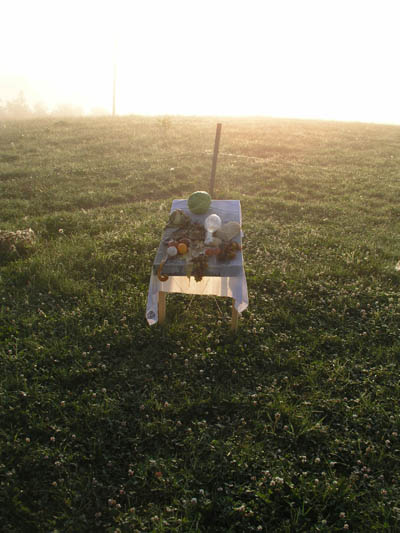
Augusta Atla posted this picture of a Robert Smithson (check, check, check) None-site. I like Smithson very much and the idea of the Non-site:

'The Non-site (and indoor earthwork) is a three dimensional logical picture that is bstract, yet it represents an actual site in NJ (The ine Barrens Plain). It is by this three dimensional metaphor that one site can represent another site which does not resemble it - thus the non-site'
Robert Smithson, 'The Collected Writings', p. 364

But looking at it this time, I got the feeling that I'd be much more interested in the surrounding information and documentation. About the actual place and proces. Though Smithson defines the Non-site as a 'three dimensional' 'metaphor' which 'does not resemble' the place it represents, he has not kept from adding that other layer. And that is the part I suppose I would dwell by the longest. Explore and dig out facts about the site and background. And perhaps create a world of my own. Which is something I don't feel the Non-site allows or invites me to do.

Someone who've done something like this is Christoph Niemann - an illustrator who blogs - Abstract City - for NYT. Here's how he introduces I Lego NY:
'During the cold and dark Berlin winter days, I spend a lot of time with my boys in their room. And as I look at the toys scattered on the floor, my mind inevitably wanders back to New York.'

I think there's quite a bit of Non-site in that. But what he does is more like the detailed documentation hanging next to (and is part of, of course) Smithsons piece. He takes known and less known characteristivs of New York, and describes them in Lego, through different types of representation:

Some are practical and instructional:


Elevations:


Diorama depicting a specific situation


Wellknown phenomenon:


Unlikely juxtapositions of scale and subject:


It's brilliant I think - see the rest. He lights his subject from numerous different angles. Which reminded me of something I read by Edward Tufte recently ... actually I think he said it in his review of the iPhone (worth watching):

'To clarify - add detail'

Of course - clarification might not be the goal exactly, but I like the principle. Tufte is the great guru of infographics, and I've been following some of his different advice lately. His website can be labyrinthic to explore, but is full of interesting stuff focusing on the visualiation of information. Fx. this piece about image annotation, consequenty used with the above pictures.

Mar 22, 2009

NBG

Mar 11, 2009

Brown Snow


The Greenlandic language (both of them?) is popularly known to contain 83 words for snow. It's a lesser known fact that in Danish you find just about as many words defining particular qualities of wet brown stuff on the ground. Sjap, sjask, smat, pludder, mudder, pløre, ælte...


Urban Communication


... I think our dear municipality is trying to tell us something here ... hmm ... it makes me wonder what proces has gone before this particular piece of urban design.

It's part of the, let's say, partially succesful and hugely debated redesign of Nørrebrogade - a major Copenhagen street.

Mar 5, 2009

Return Of The King


February, when wet heavy snow covered the city for unusually long. The Kings Garden in the center of Copenhagen. The sky looked like that 8 h. 22 min. that day. Then it got dark again. My friend The Bicycle Thief - a film reference, not an occupation. A mental state perhaps.

Testing, Testing, One, Two


Juuust testing out how blogging from iPhone works.... endless new possibilities...

Sep 19, 2008

blublu


Off to the Biennale in Venice tomorrow morning, early, early. So here's just for your pleasure a fantastic street art animation by Blu:


MUTO a wall-painted animation by BLU from blu on Vimeo. ... and I must remember to thank Mauro for the tip :) BLU is definately a new favorite.

For more on street art go to - I think - the web's top blog in that field: woostercollective.com

Sep 9, 2008

Beyond Architecture


M FUKSAS D

As I'll be going to the Architectural Biennale in Venice in a few weeks
I was checking up on this years theme... and... I was very happily surprised:

Out There: Architecture Beyond Building, points out what should be an obvious fact: architecture is not building. Buildings are objects and the act of building leads to such objects, but architecture is something else. It is the way we think and talk about buildings, how we represent them, how we build them. This is architecture. More generally, architecture is a way of representing, shaping and perhaps even offering critical alternatives to the human-made environment.

Reading this brought me back to my first day at The Royal Danish Academy of Fine Art's School of Architecture. Specifically it brought me back to the very moment the introductory lecture peaked. Thit happened when the lecturer came to the rhetorical question "what is architecture?". Insterestingly it turns out that architecture is defined by just three, very precise, parameters:

1 ARCHITECTURE IS TIED TO A PLACE

2 ARCHITECTURE IS LIMITED BY IT'S OWN MATERIALITY

3 ARCHITECTURE IS ... SOMETHING ... SOMETHING ... WHITE CARDBOARD
... unfortunately I have long forgotten that third parameter, but I feel I'm not that far off with white cardboard. What I find striking about this definition - and so overwhelmingly opposed by the theme of the Biennale - is how static it is. "Tied" and "limited". Reducing the role of architecture to a physical object. Excluding anything mobile or anything virtual. Denying the existence of time.


Erik Adigard / M-A-D & Chris Salter - Chronopolis

This is the prevalent take on architecture amongst the big fat guys at the Royal Academy in Copenhagen. It could be their own problem, but depressingly they are persuing this idea, by actively worsening conditions for different takes on the subject of architecture.

I suppose a typical behaviour from men who reach a certain age having shown less talent at producing something just vaguely fitting their own definitions, than the talent of acquiring an academic chair.

At the same time, fabulous spaces are possible. We can see them in film and in art, where visions of other places unfold in front of our eyes. ... We can watch them grow around us in the carefully planned landscapes that have become our last true public spaces.

These images and spaces are worth looking at not just because they are beautiful, but because we are confronting design challenges for which buildings are not enough.


Read on


Kowloon Walled City


My new hero Aaron Betsky is curating this years Biennale. I am slowly changing my plan of spending all the time there eating and strolling.


Aug 13, 2008

Georgia Georgia


The above pictures are from Georgia and South Ossetia this past week. More pictures at The New York Times here and here. Some of them disturbingly beautiful.

What happened last friday makes me feel sick - will the stupidity never end. Probably not. And while Putin enjoys the possibilty of a fresh little war to keep the minds of his ignorant voters occupied for another decade or so, I am really, really wondering what dreams and hopes president Sakhasvili had last thursday when he send in the troops.? Or rather - what the fuck was he thinking? Naive thoughts of future greatness? This war seem so absurdly meaningless. It's outcome so depressingly predictable.

The only one to benefit from this is Putin and Russia.


By Surrend via Politiken. It's an ad the Danish artgroup Surrend put in the biggest Georgian Newspaper some days ago.

Surrend are great. They've done a number of other artistic interventions like this.

We need more disinformation. Otherwise we go mad.

Georgia Georgia
no peace I find
Just an old sweet song
Keeps Georgia on my mind

Jul 23, 2008

Memories


Apr 4, 2008

Secrets & Lies


Night spend at dinner/workshop discussing a project on the subject of abandoned buildings and secret places.

Here are some of the things that came up:

abandon.dk - a map of abandoned - but now, no longer secret - places in Danmark

organiseret adgang - a very secretive guy who create "offices" in direlict buildings

crimson - Dutch urban and architectural thinking

Rana Hadad - Lebanese artist, graphic and web designer

Mar 25, 2008

Knitted Heart


sarahillenberger_01.jpg, originally uploaded by WurzelStock™.

Sara Hillenberger, "Völlig Weichgestrikt" , She's also knitted the brain and the intestines.

The project "Hochgekocht" is also a bodily delight - if Arcimboldo had been into sculpture...

Mar 24, 2008

Street Poetry


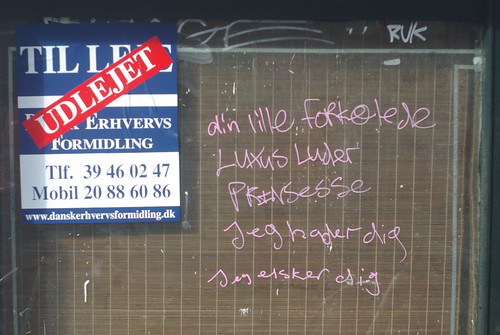
On my way to work the other mornig the soft city revealed itself. The dynamic, ephemeral, performative city. Allowing its inhabitants to leave their marks and tracks, letting itself be inscribed. Inviting to be read. The city as a medium. Supporting expression and impression. Of sensations, situations, stories and parallel realities. Creating the framework for urban consciousnes and identity.

That particular morning it revealed a desperate message of paradoxical love:

you little Spoiled
LUXURY Whore
PRINCESS
i hate you
i love you


Mar 4, 2008

Elastic Minds

starting very slow again

Exhibition at MoMa called Design and the Elastic Mind

Found it at Kottke - good thoughts and more to find there...


Love

Sep 11, 2007

Prince vs. MJ


I'm dead-tired and lazy so here's an easy one for you - James Brown asking first Michael Jackson, then Prince on to the stage. And we see Prince out-funkin' MJ 10 time and out-rock'n'rollin him 100! Oh yeah.

Must've been a rather nice little intimate concert experience.

Sep 9, 2007

Disgust vs. Lust

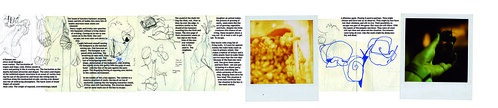
And now I would like to present essayist, architect, artist, sportsman and now also guest blogger - Tine Bernstorff Aagaard - who've written this delightfully vulgar text as part of the Food Workshop on easa007 in Elefsina, Greece. All text and images by her.

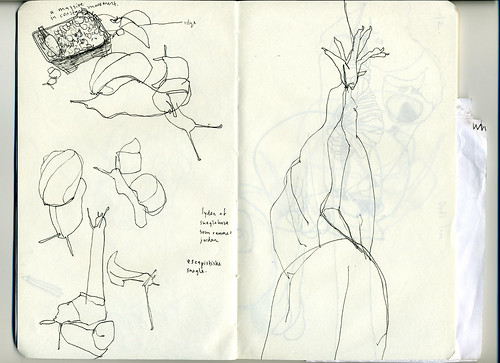
snails.jpg

Disgust vs. Lust

A flaneurs sensitive stroll through a meat market. The fascination of organs and limbs; cold, lifeless as well as warm and pulsing in the mediterranean evening sun. The fascination as the duality between attraction and disgust. The colors and shapes of the exhibited organic structures in an ocean of variety teasing the eye of the perceiver and forces the willing body to continue along the meatpacked arcade; moving even deeper into the all embracing atmosphere. The harsh smell of blood lingers all around.
Meat color. The weight of exposed, overwhelmingly naked body parts as one would never relate to living creatures. A somehow structured mess that does not catch the viewers eye. The Sound of butchers hammers smashing bones and bits of bodies into more bits of bodies and more meat atoms are released.
Heavy laughs and tricksy sale speaches hits bypassers without a living chance of avoiding. Coming on to one as one comes on to the flesh. One cant escape; not even ones own desire to stay.

drawing4.jpg

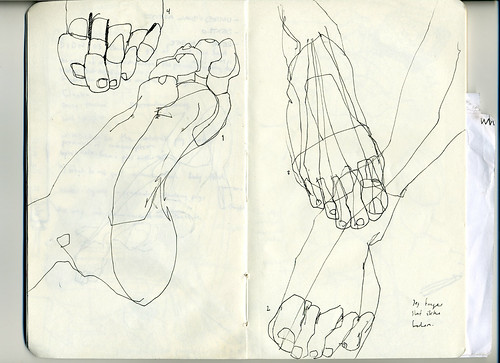
Caught between oneself sensing the body parts as the butchers sensing one. One becomes an object. The foreigner is exposed while sketching. The breathing on ones neck. Eyes on the paper. On one. The lust of investigating every little shape, deformation of the body parts. Like stroking the slightly sticky skin gently with the palm of ones hand - with the line of the pen against the pure paper. The disgusting feeling of exposing ones desires in this ruthless environment.

drawing2.jpg

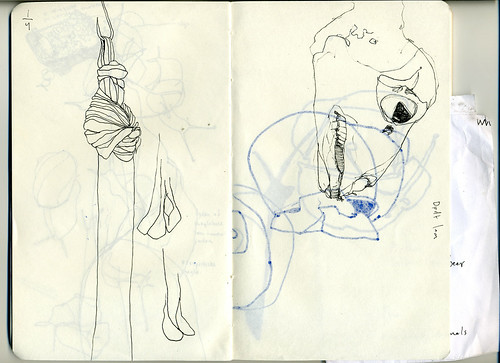
In the middle of this a box appears. The content is a massive structure of snails. Moving all on top of each other. Looking like the hanging stomachs would, if they were still functioning. The structure lets some snails depart to escape. The sound of the shells hitting the tiled, wet, floor as they tip over the edge, is somehow similar to the should of the hammers smashing into the flesh and bones. The slow page of their movements seems so fast due to the fixed time of the massive 'stilleben' one is situated in. The roughness of slaughter an animal makes the process of growing of snails, seem more like the act of growing vegetables and fruits. Despite the little creatures slim chance of surviving, these escapists shows a way out. Or at least a will to get out. To escape.

drawing3.jpg

One leaves with a bag full of living snails. 3,5 euro for approximately the make body count as class in primary school. One makes a habitat of lettuce and a white plastic bowl to make them survive more than the two days because of the heat one were told. One gives them names and have them - not just participating in a dinner party, but even controlling the whole autonomy of the evening. Keeping them alive for how long? This situation is even more artificial than the situation in the box in the meat market.

A dilemma again. Playing it passive perhaps. Time might choose and leave one as an observer. They might by now have lost their sliminess and will to live. Their possibility to escape was part of the game. But most are still there. With the names of the peoples one know. They were all most still last time one observed the situation. Excrements were lying all over. Like the snails might be doing now. Dry and dead.

Sep 7, 2007

Sonnendeck


Sonnendeck by PeterLicht

And have a nice weekend :)

Sep 6, 2007

I Feel Like Chicken Tonight


This artist, Jonathan Harris, writes amazing pieces of software. Software which maps nothing less than the mental state of the world. The results are some very poetic interactive maps. It's done by collecting data from the internet. A concept that has been tried in many variations before. What is special about this stuff is the extremely clever ways these data are treated and visualized. Fx. in We Feel Fine which maps the emotions of the world. It would be more precise to say emotions of the blogosphere perhaps... but anyway - the results seem really quite advanced and poetic, so go and play.

Newer and even more interesting than We Feel Fine is Universe - a modern mytholgy.

But before you start playing and exploring these worlds of his (or us) do yourself the favour of spending 20 min. of precious mindless browsingtime and whatch his speach from the TED conference this year, to get a very prober explanation of how these interactive maps work.

I feel like a map of myself.

(and thank you Luis for bringing my attention back to Ted's YouTube channel :)

Sep 5, 2007

Destroy All Symbols

Athens Street Art
Coming down from the Acropolis a certain side of Athens opened itself up to me when I practically walked into this piece. Like nothing I ever saw before. Body of glued textiles and mouths of cut out prints. On top of layers upon layers of tags.
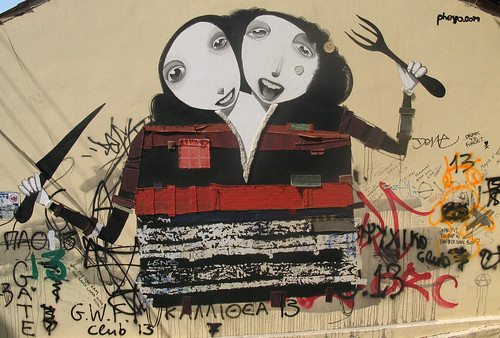

by Pheyo

I hadn't noticed anything walking up. Possibly also to do with the waves of salty sweat washing down my forehead into my eyes. But when my eyes had been opened the pieces were everywhere. Lots of different styles.
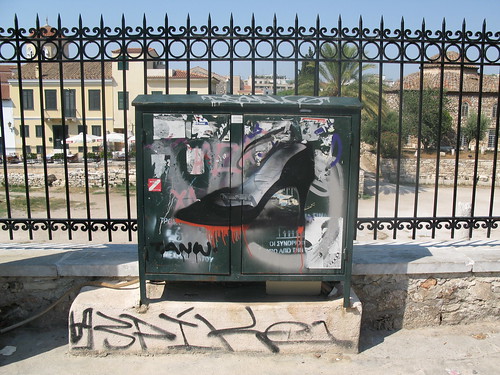
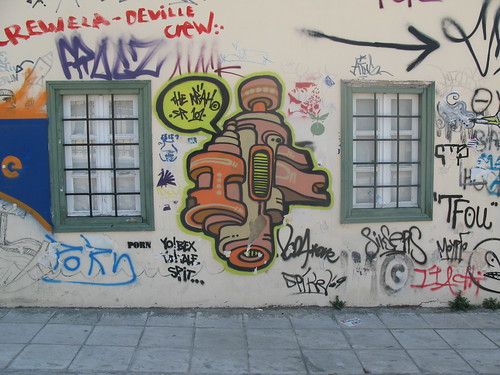


Tags all over. In thick layers. Making me wonder if the strong street art scene of Athens might be a product of the municipal authorities relaxed attitude towards keeping everything neat and tidy.


I love how street art turns the walls of the city into a media for site specific mass communication. Though most often rather abstract mass communication. In contrast to the definite and predictable messages of advertisement. And then we are closing in on the core of what makes this stuff both fantastic and important.

Ostranenie
Ostranenie - a term I've touched on one or two earlier occasions, translates into defamiliarization. It was coined by the Russian formalist writer and critic Viktor Shklovsky who views this mechanism as the trues essence of all art.

This is what he writes in his essay/manifesto Art as Technique - here conveniently highlighted for efficient blog-reading:

# 13. If we start to examine the general laws of perception, we see that as perception becomes habitual, it becomes automatic. Thus, for example, all of our habits retreat into the area of the unconsciously automatic; if one remembers the sensations of holding a pen or of speaking in a foreign language for the first time and compares that with his feeling at performing the action for the ten thousandth time, he will agree with us. Such habituation explains the principles by which, in ordinary speech, we leave phrases unfinished and words half expressed. In this process, ideally realized in algebra, things are replaced by symbols. Complex words are not expressed in rapid speech; their initial sounds are barely perceived. Alexander Pogodin [in a 1913 work] offers the example of a boy considering the sentence "The Swiss mountains are beautiful" in the form of a series of letters: T, S, m, a, b.

# 14. This characteristic of thought not only suggests the method of algebra, but even prompts the choice of symbols (letters, especially initial letters). By this 'algebraic' method of thought we apprehend objects only as shapes with imprecise extensions; we do not see them in their entirety but rather recognize them by their main characteristics. We see the object as though it were enveloped in a sack. We know what it is by its configuration, but we see only its silhouette. The object, perceived thus in the manner of prose perception, fades and does not leave even a first impression; ultimately even the essence of what it was is forgotten. Such perception explains why we fail to hear the prose word in its entirety (see Leo Jakubinsky's article) and, hence, why (along with other slips of the tongue) we fail to pronounce it. The process of 'algebrization,' the over-automatization of an object, permits the greatest economy of perceptive effort. Either objects are assigned only one proper feature - a number, for example - or else they function as though by formula and do not even appear in cognition.
And then you get the next part full length...

I was cleaning a room and, meandering about, approached the divan and couldn't remember whether or not I had dusted it. Since these movements are habitual and unconscious, I could not remember and felt that it was impossible to remember - so that if I had dusted it and forgot - that is, had acted unconsciously, then it was the same as if I had not. If some conscious person had been watching, then the fact could be established. If, however, no one was looking, or looking on unconsciously, if the whole complex lives of many people go on unconsciously, then such lives are as if they had never been. [Leo Tolstoy's Diary, 1897]

# 15. And so life is reckoned as nothing. Habitualization devours works, clothes, furniture, one's wife, and the fear of war. "If the whole complex lives of many people go on unconsciously, then such lives are as if they had never been." And art exists that one may recover the sensation of life; it exists to make one feel things, to make the stone stony. The purpose of art is to impart the sensation of things as they are perceived and not as they are known. The technique of art is to make objects 'unfamiliar,' to make forms difficult, to increase the difficulty and length of perception because the process of perception is an aesthetic end in itself and must be prolonged. Art is a way of experiencing the artfulness of an object: the object is not important. [This key statement has been translated different ways; Robert Scholes, for instance, renders it as: In art, it is our experience of the process of construction that counts, not the finished product.] (from "Art as Technique" - click for full text)
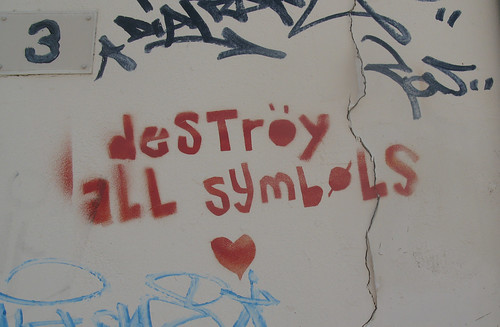


After rereading Shklovkys text the above statement suddenly made sense. How you can destroy symbols with symbols.

One street artist who really take this effect of ostranenie to the sublime is Banksy, so in his concise words:

If you want someone to be ignored then build a lifesize bronze statue of them and stick it in the middle of town.

It doesn't matter how great you were, it'll always take an unfunny drunk with climbing skills to make people notice you. ("Wall and Piece", p. 208)


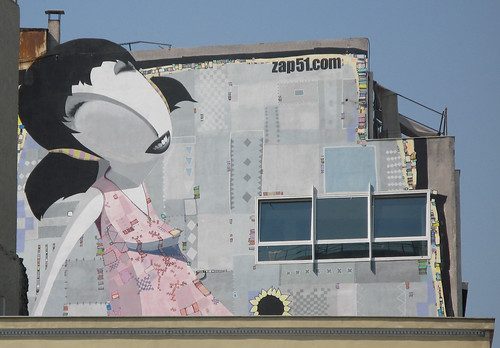
It draws us out of the white noize of our everyday routine and draws our attention not only to itself - but also to the space around it. And our bodys place in relation to that. Allows us to locate ourself both geographically and mentally in the urban space.
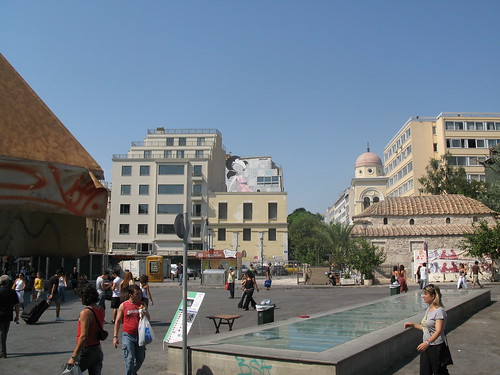


Wheeew - that was a rather long and rather messy one... a beer to anyone who followed me this far.

Sep 3, 2007

Can Touch This


I've been dealing a bit with advanced interface-design before, here & here. And in fact what Jeff Han is doing here is not really different from what Microsoft Surface can do. He just have a much better idea of what to use it for. In other words - this is so much more useful fx. looking at graphic visualizations of complex data, where the ability to both see the big picture and infinitely small details is important... rather than using it as an interactive sofa table... thank you microsoft for really making a difference.
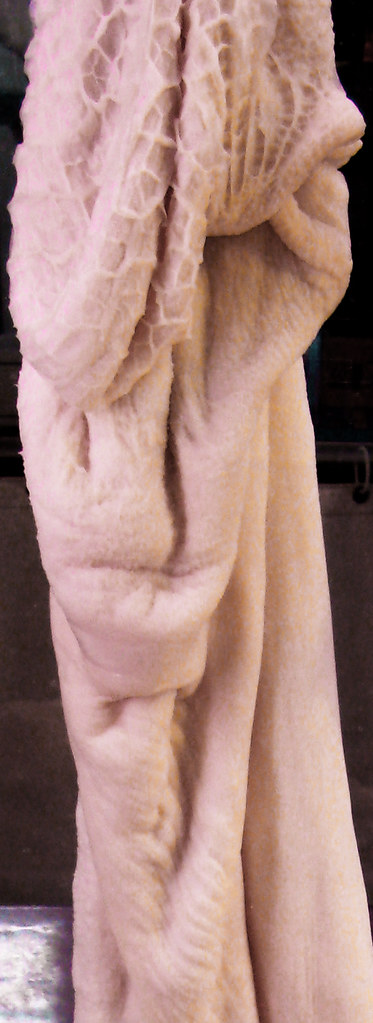
Towards the end of the interview he says something really interesting about a possible 3D-version. It turns out the actual problem with this is that the human body has great difficulty doing very presize gestures when it doesn't have anything to push against. It's the problem of keeping your fingertip in an excact point in space, while taking a step to the side. Something that's very easy to do if you rest it against a wall.

So maybe even Jeff Hans design is a dead end too. Lot's of more videos of this on Youtube.